Showing posts with label 52ancestors. Show all posts

Friday, March 24, 2023

Candles in the snow

It is Christmas Eve in Germany and the anticipation of the advent season approaches a fever pitch. There is a bustle of activity as last minute preparations are made--shopping had to be finished by noon, last-minute packages are still being wrapped and hidden from children, mothers are scurrying about everywhere, and children are banished from the living room while the tree is put up and decorated behind closed doors, to be revealed at the sound of the bell.

In my husband's childhood home in Ravensburg, there is a mix of the German and English all year long, but Christmas Eve is all German; after supper my late father-in-law would take a daughter or two to evening mass at the Liebfrauenkirche, knowing there would be the opening of gifts--the Bescherung--upon their return. 

Winters in Ravensburg are usually white, and the snow shovel and a tub of sand for the steep front steps are a quasi permanent fixture during the winter. As soon as the churchgoers head out, Mama digs into a box and pulls out a handful of candles. Right before their return, she tucks lit candles into the snow banks lining the steps and walkway leading to the front door. The warm glow welcomes them home on one of the darkest nights of the year.

Candles light their way home


Sunday, March 12, 2023

Bad luck, good luck

But for luck (and not just good luck), many, if not most of us, would not be here.

In 1949, a boy was born into my maternal Grandmother's family; on that auspicious occasion, the boy's grandfather, Howard Beck Cutting, typed a six-page letter, which included some tidbits of family history. We all know that lore almost always contains both bits of truth and bits of conjecture as we strive to fill in the blanks (in both personal and world history), but it does make for a good story.

And so it was with the improbable tale of how a young man from Massachusetts met a young woman from Tasmania. I'll let excerpts from Howard's letter tell the tale:

You know Tommy, you had a very narrow escape from not being here at all. Way back in 1869 a train had stopped at a little station in California to take on passengers, and having done so it had started up to continue on its way. A man running to catch that train failed to do so by a slight margin. Perhaps he was very much disgusted with himself for having missed it, however, I am sure that he was glad he had done so. If he had caught it there would have been no Tommy Cutting. 

[…]

Great-great grandfather and great grandfather had learned the painting trade and they went into business in San Francisco. They accumulated some property, however, for one reason or another such pieces were sold, presumably at a profit. It was during this period of their work in San Francisco that great grandfather [Eugene Augustus] Cutting took a day off in 1869 to go to Redwood City. A railroad had been constructed from San Francisco to San Jose 50 miles south of the city. He was the man who missed the train back to San Francisco and during the interval while awaiting the arrival of the next train he met Mary Beck.

Drawn by the rush for gold in California, the family of Eugene Augustus Cutting had come to San Francisco from Sudbury, Massachusetts; The promise of gold and riches also brought Mary Beck's family to California from Launceston, Tasmania. Eugene and Mary were married in 1869 in Redwood City, San Mateo, California, and had four children. 

As if that wasn't enough good fortune, they lived through the San Francisco earthquake and fire of 1906. The fire was ultimately stopped only six blocks from their home in the Mission District.

Eugene Augustus Cutting and Mary Beck

+++

As a postscript, the baby boy to whom the letter was addressed passed away just a few months ago, after two-year battle with a disease that finally took him, all too soon. 


Saturday, March 4, 2023

Fraktur, Kurrent and Sütterlin, oh my!

This year, I reached an important milestone: when I renewed my membership in our national professional association for translators and interpreters, I qualified for the life membership category, which is reserved for people over a certain age threshold and with more than two decades as a member. It is fitting, as I am wrapping up a lifelong career as a professional translator that began with studying French in high school oh, so many years ago. 

Those studies led me to a year in France, which led to me meeting the German man who would become my husband, which led me to return to Europe to do graduate studies, which led me to learn the language of my future in-laws, and eventually to marry said fellow (bonus: today is our anniversary). What I did not know was that my esoteric studies in paleography of middle and old French (and the ensuing thesis) would be of use later, not in my career, but in my personal activities in family history. 

As someone who received stacks and diskettes of "completed" genealogies, the prospect of tracking down my husband's little known family roots appealed to me. There was only one catch: even though the German and French languages pose few problems, the handwriting did. 

Modern French handwriting is a well-known entity to me; the older scripts, while still characteristically loopy, demonstrate the roots of a fairly straight evolution and are readable, especially if you are familiar with the language. But German posed a real challenge: first came Fraktur--what we would call blackletter--for printed materials. To my chagrin, after I learned the alphabet, using a printed chart from the 1950s, I discovered there is now an online tool that can perform optical character recognition on it. But once I move up the tree in smaller villages, it became apparent that church books written in Sütterlin and the older Kurrentschrift (and many others) were simply not in my skill set. Heck, I still had trouble deciphering my father-in-law's letters to us from this millennium (which turned out to be a mix of the Sütterlin he learned as a child overlaid with the postwar deutsche Normalschrift). 

But the same techniques that served to help me decipher medieval French manuscripts were of use here: using known words (often set phrases) in the document to establish baseline characters; looking at each letter separately (covering surrounding letters with your thumbnails or slips of paper is helpful); drawing the pen strokes in the air to understand the motions of the scribe--which letters were they trying to form? People writing by hand often omit things, or the hills and valleys of 'm,' 'n,' and 'w' may not add up--especially in longer documents. People have been getting writer's cramp for centuries, it appears. 

I can now add Sütterlin and Kurrentschrift to my toolbox; as a bonus, I can now read my father-in-law's journals. So even as family researchers sometimes curse the scrawl of census-takers (and celebrate beautiful penmanship), I try to take a moment with these documents, and feel the motion of their pen, which tells you a great deal of their state of mind while writing these things down--not just for their own use, but for us, their future generations. 

Anton Hellstern
No longer a secret code


Sunday, February 26, 2023

With her grandmother

In genealogical research, as in life, we expect things to happen in a certain order: people are born, get married, have children, and die and are laid to rest. Their children survive them, and follow the same pattern. Perhaps because this is our expectation, the exceptions seem stark reminders that nothing in life is a given. 

When our daughter was stillborn, our world fell apart; nothing seemed to make sense. I realize now how incredibly difficult it must have been for our parents, who were not expecting to outlive their grandchild, having to deal with being unable to spare their own adult children the pain of losing their child. 

Several months after her death, I had a dream, where a colleague who had recently passed away came to me at a disjointed cocktail party, and told me that he wanted me to know that our daughter was with my grandmother. I woke in tears, partly because of the rawness of the loss (which remains), and partly because I knew exactly how loving my Grammie would be to her. 

Child and infant loss is unfortunately common in every family tree, but it is rare to find anything more than a record of a birth and then a loss. Every now and then, they appear in a census record, but more often the child has no name, and no record even exists. So imagine my mitigated joy in seeing how a father recounts his daughter's brief existence in his family notes in the back of the his journal:

"Caroline Lucretia - my first daughter died at Hastings Minnesota September 3d 1856 - about 11:00 o'clock at night. She was buried in the Hastings cemetery, but was removed and buried in County Line cemetery [...] My mother and daughter rest in the same grave—marked by a small granite headstone."

A daughter lies with her grandmother


Tuesday, February 21, 2023

Stars and flowers

As the daughter of the family historian, one of the hardest things to contend with is the physical and emotional weight of the records and artifacts passed down through the generations. My family was blessed by having prolific writers: we count easily a half-dozen journals, from the sweet recounting of a teenage girl's wardrobe and school crushes to the hefty and pensive journal of a Civil War chaplain (and that of his wife and son). These all have a physical presence as well as capturing not only our family's history, but the history of our country at a key moment.

After my mother died of Alzheimer's, I had the arduous task of combing through disorganized piles of family and historical research (she was a published historian), interspersed with decades-old bank statements and direct mailers for things she would never buy. Deciding what to keep and what to discard, what to take to my home and what to let go, was a difficult decision, complicated by my difficult relationship with my mother. As I can now take time to comb through her work and read her journals (yes, she kept journals as well), I have come to better understand and admire her accomplishments. 

But by far and away, the most difficult piece has been what to do with her unfinished projects. I admit to the same overachieving tendency that she had: to start projects. It's a little like knitting a sock, and wondering if you will have enough yarn to complete it; will I have enough days to complete them? Adding my mother's projects to the pile adds a new level of stress--I have my own projects! Is my time to be used finishing hers? 

As I dig through the piles of family artifacts, I find a box  labeled "Civil War blanket" which I always assumed was the blanket that my GGG Grandfather had used many a night on the cold, hard ground. Instead, I find what looks to be odd scraps, but turns out to be a partially pieced Ohio Star quilt top with a label pinned to it. It was begun by a great aunt in 1867, the year she turned 19, the year she graduated from Hamline, and the year she was married. In less than two years, she died of consumption, leaving behind a bereaved husband and an unfinished quilt. 

Underneath that box is another dress box with stacks of hexagonal "flowers" destined for a grandmother's garden quilt. Some of the fabrics I can identify from my mother's scrap pile as being from garments she sewed for us; others appear to be of her mother's and grandmother's vintage. 

Turning the work to the wrong side, I can see that all the stars and flowers are hand-stitched. These two incomplete quilts are a physical reminder of how our time is borrowed. Stiches in time.

I keep chipping away at my own projects, but I have also found a local quilter who is enthusiastic about helping finish both quilts. Hers will add a third generation of hands and stiches to the mix. I find comfort in being able to honor these women, and to wrap myself in their handwork, and I hope they will share that same sense of accomplishment when you can fold up a beautiful thing, and say to yourself, "done." 

Ella's quilt: begun in 1867, finished in 2023


Thursday, February 9, 2023

Very social media

When they were little, our kids had a well-loved book called Post für den Tiger ("Post for the Tiger"). In it, Little Tiger misses his friend Little Bear, who goes off to go fishing. He eventually hits on the idea of asking Rabbit if he could carry a letter home to Little Bear (he even remembers a stamp!). Rabbit happily obliges, and as word gets out that Rabbit delivers letters, he is given a uniform cap and they put up a few mailboxes to make Rabbit's life easier. 

Without doing a great deal of research on the world history of postal services, I can imagine it's not too far from reality. Messengers have existed since time immemorial, starting with people carrying individual messages, and eventually becoming available to the masses of Tigers and Bears who miss each other. 

Technical advances were adopted in their own time: rail transport, commercial ships at sea, air mail, and even a flirtation with rocket mail (sometimes called Missile Mail). Several countries theorized would be feasible as early as 1810. Practical experiments were conducted by many countries, and were abandoned as accuracy for the landing was difficult, especially in the context of getting mail from one large city to another. 

In a time before Zip codes, I remember the mail came twice a day. And even though my mother lived only a mile away from her mother, the letters went back and forth daily. The letter from Grandmother would arrive one morning, and my mother would pen or type her response in time for the afternoon pickup; Grandmother would receive it the next morning, and her response would go out in the evening post. After a year or so, they would return the letters to each other to serve as a quasi-journal. There were many dozens boxes of letters when we cleaned out her house, and we were simply not able to keep them all. 

Their correspondence continued throughout their lives, even as time and technologies inevitably marched forward: first to fall was the twice-daily post. Then came Mr. Zip®, the USPS character who introduced us to five-digit codes (instead of the combination of city and a two-digit code). We moved to a smaller town, and the morning mail came around midday; a move to a more remote place meant another day's delay and afternoon delivery. The price of stamps went up. And up. And yet, the two kept writing. I'm not sure what my Grandmother would have thought of nine-digit codes being scanned and sorted by machines.

But somewhere along the way, a pattern emerged: as I read through reams of chatty communications between them, there were holes, and they usually corresponded to major events like births, sudden illnesses, and deaths. The explanation was obvious: we started to pick up the telephone to make calls when the news couldn't wait a few days. 

The other casualty to time was a round-robin letter between the large family of cousins sharing the same grandfather. Every few months, a fat, worn envelope with layers of address stickers and a couple dozen letters would arrive at our home. We would read them all, then take out our last letter and insert a new one about the happenings of our family since then--sort of like an interim Christmas letter. There was always one cousin who had to be reminded that they needed to keep the packet moving, but it worked for decades.

Alas, two things spelled its demise. The first was the advent of email, which was not adopted by all at the same time. The second was that as the cousins aged and passed away, those names and letters dropped from circulation. The big manila envelope got thinner and thinner, until it was eventually replaced by group emails from and to those who used such things. 

The good news is that my mother, as the family historian, kept many years' worth of family round-robin letters; as I work my way through the relatively manageable stack, I hope to uncover more stories and pieces of information that help paint a more complete picture of who we come from. 

One of many letters from mother to daughter


Sunday, January 29, 2023

In the linen closet

When I was a young girl, I loved to sit next to my grandmother and listen to her stories. It was on her lap that I learned to read, and first heard of the Mormon Tabernacle Choir and Lawrence Welk. She was a thoroughly modern Millie, and had a remote control--with a mute button!--in the 1970s. She had a disability that made walking difficult, so spent much of her time in bed or in a custom-made chair that made it easier for her to be comfortable. 

One of those mornings, she told me the story of how she was invited to christen a ship in Japan. She recounted how the Japanese didn't just have a bottle of champagne broken across the bow; they had developed a mechanism that included a silk cord that had to be cut across a block with a silver hatchet in one stroke. They provided her with a hatchet to practice, since it was purportedly bad if she failed to cut it in a single blow--sort of like birthday candles. She told of the day of the christening dawning very cold, how she was very nervous, and how it rained when she cut the cord--successfully.

Then she called to my grandfather Russell, asking him to bring her the hatchet to show me. He stepped over to the linen closet, of all places, and reached in and pulled out a beautiful presentation box, painstakingly inscribed with the date by a hand not used to the roman alphabet. Inside were nestled the hatchet, along with a section of the red and white silk cord and a cedar chopping block that showed a clean cut. 

Years later, we would find a folder of the official photographs, along with a VHS tape my uncle had made of the 5mm film that had been gifted to Jessie and Russell. It was a remarkable experience to see the event she had described that day (and many times later on as she slipped into the fog of dementia), and especially moving to see her alive and hear her voice. 

My eldest cousin James also enjoyed listening to the grandparent's stories, except he followed my grandfather around. Russell was a wiry, vital man who always seemed to be in motion--except when he sat down to watch golf. James was a budding journalist at the time, and in 1977, he sat down with our 82 year old grandfather and interviewed him about his extraordinary life, using the latest technology--audio cassette tapes. 

Shortly after my mother's death, I asked him if knew what had become of the tapes. He was in the midst of moving and preparing a book for publication (The Abolitionist's Journal) and told me he would keep an eye out for them. After the California storms of last month dropped a rather large tree on his home, he made a concerted effort to find them. Of course, it was his wife who located them--in the linen closet, of all places.

They are currently in the hands of my favorite digitizer. I'm hoping the result will contribute to these family history musings. 

The fabled hatchet in its presentation box


All the rights and privileges pertaining thereto

I have in my possession some extraordinary documents. Most of our efforts as genealogists center around locating records of birth, marriage and, death. But these are personal milestones: university diplomas.

But what makes diplomas extraordinary is not just the date--though it places them in a societal context--but also the names: my grandaunt Ella Richardson, and my mother, Madge. Both women, at a time when women did not typically earn degrees.

Ella and her sister Florence both attended Carleton College in Northfield, Minnesota, which was just a few blocks from the family home. Ella earned a BA and graduated in 1906. Seated one person away in the front row of the class picture is her sister Florence; behind them are Ella's future husband Bernard Street and his brother Claude; the four were the subjects of a double wedding the following year. In the Carletonian's senior number (edited by none other than Florence and Claude), the class picture is flanked by portraits of the valedictorian and salutatorian; Ella is the valedictorian. 

Ella went on to become a schoolteacher of German and History--until of course, she had their first child. In 1918, when she was six months pregnant with their fifth, her world fell apart when her husband was killed in a hunting accident. The family rallied around her, and she spent the next couple of years regrouping in her parent's new home in Sutherlin, Oregon. She eventually returned to Minnesota, where she lived out her days and is now buried near her dear family.

At a time when women might begin college, only to drop out once they had earned an "M.R.S." degree (witnessed by the number of wedding invitations from sorority sisters pasted in her junior year scrapbook), Madge bucked the trend. After having finished her Bachelor's in Dramatic literature from the University of California Berkeley in the early 1950s, she asked her father for support to pursue a graduate degree. He agreed, on one condition: that she prove she could support herself for a year. I recall her dexterous fingers on the typewriter (later the computer keyboard), and she told me she had had a lot of practice. She had met her father's requirement by working for a year as a secretary for Del Monte (the canned tomato folks). Satisfied, he paid for her graduate degree, this time in anthropology with a focus on ancient Egypt. Her thesis sat on a shelf next to a fat book on Hieroglyph Grammar in my childhood home. 

I keep family documents on the shelf in my office. On the wall near them hang three diplomas with my own name on them. The roots in my tree are thick with extraordinary women, and I have the documents to prove it.


Monday, January 2, 2023

Mystery dinner invitations

It's one of those interview or cocktail hour questions: If you could invite [insert number here] people, past or present, to dinner, who would you invite? Common responses are people like Albert Einstein, Johnny Cash, and even Anakin Skywalker. 

But to the family researcher, this would be an amazing opportunity. I would love to hear from my great-grandmother Julia about the love affair that brought her daughter into the world--and how she felt about that daughter finding her birth father as a grown woman. I would also ask if she actually married my great-grandfather, and what on earth they were doing having a baby in a mining town in Nevada when their lives were in San Francisco. 

I would also invite my great-grandfather, who accepted Julia, a woman with a past (and a young daughter), and gave them his name and heart. I would want to talk to him about why he split from his family in New York, how he got across the country (was he aiming for San Francisco, or is it just where he ended up?). I'd also love to know how, if he wasn't speaking to (or about) his family, did he end up with his older brother's trophy. I actually would love sitting down with the entirety of the New York Walshes, even if they might well empty my stores of whiskey. 

I think I would enjoy talking with my great uncle Vincent, who drove a flashy car, married a new-age German woman (who sang opera and penned poetry), and who left his house to his secretary, a spinster who kept the business running while he was living it up with his wife. He's also the younger brother who stepped up for his nephew when my grandfather died prematurely. As an aside, I would let him know that we share a birthday, and ask if he knew the circumstances of his birth. We'd probably share some laughs, too. Of course, I'd set the table with his wife's silver, which was passed on to me. 

I might also include my Grammie, with whom we shared meals every Sunday, and for all her commitment to family research left us precious little about her own life and family. I know she was social, and I would love to sit with her, and have her tell me who the smiling people in the group pictures were. I'd really like to ask about George, who is clearly her beau, but did not become her husband. We would use her silver, monogramed with her maiden initials on the table.

I would be beyond ecstatic to fill my weekend calendars with dinner parties for each and every one of my brick walls, but alas, that is not part of the question, and those amazing conversations will never take place. 

They say that dead men don't speak, but the fact that part of them literally forms part of us in the form of inherited DNA, does give voice to them, confirming the family lore, or exposing secrets buried over the generations. Those of us with stamped letters and envelopes sealed with a kiss and Victorian hair art will hold on to them, as they may allow our ancestors to speak once more, even if we can’t invite them to dinner.

A message from the past that may speak to us


Wednesday, December 28, 2022

Waste not, want not

In the 1920's, my Great Aunt Ruth Richardson came to Sutherlin, Oregon as a bride. One of her letters written back home to family in Northfield, Minnesota talks about when she went out to the springhouse to get some butter for her mother-in-law:

"And this is what I saw - shelves all the way around filled with jars and jars of canned fruit! I am going to offer to get the butter and cream every meal and count them.

"...Tonight I went after butter again, and I asked Mother Morgan if she would think me dreadfully snoopy if I counted the fruit jars. Now, darling, you simply have to believe me - there were six hundred quarts, and jars and jars of jam, preserves and chow chows, and a big immense jar of wonderful pickles. There were the most wonderful assortments of fruit, meat, fish and vegetables, and she had done it all herself. She is just so nice and modest about it; I'd think anyone who had done that ought to broadcast over the radio. And then she said in that nice quiet voice of hers that I am learning to love and respect, "But I canned a few more this year than usual." And what do you think she said? That two hundred of them were for us. Jim had bought the jars and sugar and she canned them."

The first time I met my husband’s aunt, she was in the kitchen of her farm in Southern Germany, cutting brown bits off a head of cauliflower, her fingernails blackened by soil and paring. My father-in-law did much the same with shriveled apples, taking them one by one from a cardboard box next to his chair. I recall being repulsed by the condition of the produce; indeed, it was the kind of stuff you would see in dumpsters in this country, never in the stores. But these people had been through a war on their own soil, and knew what being hungry was like. For my generation, who has lived in a world at war for nearly their entire life, there is no shortage, no hardship.

As I child I remember my mother parking close to the fence at the bank so my brother and I could stand on the hood of the car and pick blackberries while she did her banking. We had purple tongues when she returned, but there were enough for some on ice cream later, and even more that she turned into jam. She enlisted our help in stirring jam and canning peaches. In fact, on the day Neil Armstrong walked on the moon, we put up peaches: as the person with the smallest hands, my job was to neatly layer the cut and peeled peach halves in the mason jar so my mother could pour the hot syrup over them. When we cleaned out my parent's home, there was still one lone jar of "Moon Peaches" on a shelf in the pantry. They're past their prime, discolored with time, but I still packed them up (along with boxes of jars), and they sit on my pantry shelf with the other canned goods. 

And there are more than a few, as my family and friends have learned that if they bring home fruit (or pick it from the trees on our suburban lot), jam will be made. As I take my first jam of the season down to the shelves in the garage where they reside, I check seals and rotate the jars (older jam near the door, newer jars on the left). I also took the opportunity to channel my ancestor and count the jars, and did you know, there were 126 jars of jam, and 36 of applesauce! I will share some with friends who have been trained to return jars, but my family will enjoy the lion's share of the bounty and I admit to a great deal of satisfaction from seeing them, rows of soldiers ready for toast.

Yes, there is jam available to us on the supermarket shelves and farmer's market, but we all prefer following in the footsteps of our predecessors and sweating through the hot days of summer so we can spread a little sunshine on our toast on a wintry morning. 

Summer in a jar


Wednesday, November 30, 2022

Not forgotten

I have previously written of my 3GGF William "George" Beck, who sailed the seas from England to Tasmania to California, all for family. As a young man, he accompanied his parents (Becks) and aunts and uncles (Knights and Webbs) to Van Dieman's Land; as a young father, he packed up his family to try their fortune in California in the Gold Rush.

But the family with three children that boarded the Barque Spartan in 1850 headed to California was not complete. Yes, they had already buried three children (including twin boys that did not survive), but George's 12 year old daughter Sarah from his first marriage--who had lost her mother while George was at sea--is not on the passenger manifest. 

And it does not appear to be an oversight by the purser: there is no record of Sarah in any records once they arrive. In the years after their arrival, the family expands by two more daughters. George makes a good living selling real estate and building houses for miners returning from the mother lode with pockets full of placer gold. He lives a prosperous life, dying at the age of 69, with a sizeable portfolio of real estate and a passel of grandchildren. He outlived his second wife by 25 years.

So whatever happened to Sarah? When I asked my mother, she said she had always heard that she died along with her mother, or perhaps she came to California at a later date. Great Aunt Marjorie assumed she had died, since it was inconceivable to her that a parent would abandon a child.

However, digging through the Tasmanian archives (a researcher's dream: clearly scanned, indexed, and online), Launceston reveals itself as a very small town: in the 1843 census, there is an unidentified young girl of Sarah's age living at Carr Villa, her great uncle John Knight's estate. In 1851, the census names her as living with her grandmother Beck. But we hit pay dirt in the 1856 Assessment Book for Launceston, where she is not only living with her grandmother, but her aunt and uncle Webb have also moved in. Also in the list of residents is Thomas Hughes, her new husband. She is 18 and pregnant with the first of 12 children. 

When George died in California in 1882, his will appointed his youngest daughter Lizzie as administratix. His will splits the estate evenly between his four surviving children, identified by name. But the 1885 probate settlement tells another story: Lizzie and her siblings make sure that their half-sister Sarah Hughes finally gets her due: she receives 1/5 of the estate, with the remainder going to her unmarried half-sister Grace. 

The father and his four children circa 1859:
Mary, Tom, Lizzie (Elizabeth), William George, and Grace


Friday, November 25, 2022

Australian royalty

If you haven't already, you'll want to read the story of the Launceston Library.  

Picking up where I left off: I had three siblings with land grants in Launceston, Tasmania (then called Van Dieman's Land). All of them were free persons--no convicts. My great aunt Marjorie had been adamant that there were no convicts to sully our name or reputation. But I couldn't help but wonder why an entire family that had been in the same village for generations would uproot to an unknown and distant land--reachable only by a two to five-month sea voyage that was in itself an ordeal.

I learned that the English government was offering a bounty to young men with a trade, which William "George" Beck was. He was  a carpenter, and I can remember seeing the chest he made in my great aunt's house. But that didn't explain why his parents and four of his aunts and uncles made the same trip. 

Having established that we had three siblings and their spouses thanks to my distant cousin just across the Canadian border, I learned from this same gentlemen that their father, Samuel Knight, had been the subject of a trial at the old Bailey on April 25, 1814. 

The transcript from the Old Bailey trial

Samuel, a cloth salesman, had moved his family to London in hopes to improve their economic situation, but that apparently had not worked out, and on an April evening, he and his brother and a couple of cronies took a crow bar to a warehouse door and stole  some furs. Both Samuel and his brother James were sentenced to death. Both of them had their sentences commuted to transportation.

On August 7, 1815, James and Samuel were transported to Port Jackson, Sydney in Australia aboard the Baring, along with 300 other convicts. In 1830, Samuel completed his sentence, and his son John, who had moved to Launceston, applied for a land grant for his father and brothers-in-law. In 1822, two things happened: James died, and Samuel earned a ticket of leave. Samuel then requested a transfer to Van Dieman's Land. By 1829, he had a conditional pardon, though his commuted sentence meant that he could never return to England. 

So it appears that Samuel, a convict, is most certainly the reason that the three siblings came to Launceston: the timing permitted petitions for Samuel's transfer and land grants for the siblings, all taken care of by his son John. 

In an interesting footnote, George Beck's first Daughter, Sarah, was left behind with his parents and aunties when he left for California. She ended up marrying an Irish man who had also received a death sentence--for stealing a gentleman's handkerchief--commuted to transportation: during his sea journey to Launceston, the transportation system was dismantled, and he found himself a free man upon arrival (except for the option of returning to Dublin). Thomas Hughes was a watchmaker, and provided well for his wife and 12 children. There are still many Hughes in Tasmania who can trace their roots to this couple.


Secret sign

Among the treasures handed down to me is a small wicker box containing several medals and ribbons: some are from my father's military service, a whole bunch are tarnished medals from my grandfather Albert Walsh's short career as a one-mile walker, but the most elaborate are those from my grandfather's involvement with masonic organizations. Deeper research indicates that his brother Vincent was also a member of the order. Unfortunately, the fancy fez headgear did not survive. 

In his obituary we learn he was a member of "Henry Clay Lodge No. 95 F & AM, California Bodies Scottish Rite Islam Temple, Royal Order of Jesters," all part of the Masonic landscape. Sure enough, there are a number of Shriner pins (fez and sword), as well as some from the Royal Order of Jesters, naming Albert a "Light Comedian," and other bits adorned with Billiken, their chubby mascot ("The God of Things as They Ought To Be"). 

In her photo album, his mother Julia pastes pictures of Albert with his Shriner group; it seems ironic that the current Masonic Temple in San Francisco, across the street from Grace Cathedral, was completed only a year before he died.

My father knew his dad was a Mason ("wide mouth?" we would joke with innocent hilarity), but he never seemed to be a joiner; it was only in his 50s that he decided to join a church and the historical society. 

So there was some joy in hearing that in his 70s, he was invited to join The Ancient and Honorable Order of E Clampus Vitus, a fraternal organization dedicated to preserving western heritage (at the time, he was president of the Shasta Historical Society), known for placing historical markers throughout the west. But my father was never one to take things too seriously (his father was a light comedian, after all): the name of the group  is improper Latin that translates loosely as, "I believe it because it is absurd." In addition to placing plaques ("doin's"), they did fundraising for "widders and orphans," and held beer-fueled camps called colloquia. But the best part was that they had rituals: wear a black hat and a red shirt, give the "secret sign" to fellow Clampers if you should see them about town. He delighted in teaching the gesture to our toddler son; I can't tell you what it is, because it's a secret. 

Albert - back row, first on left


Monday, November 21, 2022

Rock collection

We tend to think of stone as a material for the ages--buildings and statues from ancient civilizations that we see in museums and around the globe are still with us, sometimes in perfect condition, sometimes showing their age. But weather, wars, and the choice of stone itself have a direct bearing on longevity.

Coming from a family of genealogists means that cemeteries are nothing new to me. There's always at least one big shady tree that someone had the foresight to plant many decades ago, an area with newer graves--some with wooden markers pending the final stone--and the somewhat overgrown areas with the older, worn stones. But as an adult, I learned that this does not hold true everywhere.

When I first visited my father-in-law's home town in southern Germany back in the 1980s, I noticed a sign that pointed to the cemetery. Since it was a sunny day, we strolled over. I understand now why the place looked so well-tended, and am kicking myself for not taking a photograph of DH's grandfather's headstone. For this is a typical Catholic cemetery, where plots are rented for a period (usually 80 years); any remaining bones are exhumed and placed in a common ossuary. Which means that the stone I saw that fine day is no longer there. 

So what happens to the stones? It's not uncommon to see the vestiges of earlier houses in the stones of newer ones in Europe; I imagine that some headstones are repurposed as paving stones (face down), and others may be broken up for stone walls between fields and such. But every family has its historian, and some families keep the stones. And this was the case with cousin Pia.

During one of our visits to Betra last winter, we met up with another cousin, who walked the rows with us, and helped us photograph all the graves with the family name, telling us stories about the ones she knew personally. And then she took us to cousin Pia's house. Pia herself was under the weather, but pointed us to a shed in the back corner of her garden. There, leaned up against the shed were headstones from the 1960s that has been removed from the cemetery when their time expired.

Cousins in Pia's backyard


Saturday, October 22, 2022

George's little diary

I wrote earlier about my 3GGF William "George" Beck, who emigrated to Tasmania as a ship's carpenter. His family had gravitated there when he was a young man of 18, his life spread out before him. Life was hardscrabble, as evidenced by advertisements in the local paper (owned by his uncle) that showed people serving many roles: the barkeep was also a baker, and his wife and sister sold fancy goods brought fresh from London--no doubt by young George. 

When he was 24, George married a woman named Elizabeth Ford, and within a year, they had a daughter, named Sarah. George, trying to provide for his little family, set off on yet another voyage back to England. Two things stand out: his wife died while he was at sea returning to Tasmania--just after he had crossed the equator on his easterly route, and we know this because there are excerpts copied from his "little diary" by his granddaughter sometime in the 1940s. 

The notes are terse (the diary was small?) "Feby 5th 1840 Arrived at Van Dieman's Land" (after 5 months at sea) and "May 10th gave L1 S10 for a plaid dress"--presumably for his toddler daughter Sarah, though she is not mentioned by name. There is also no entry copied for his second marriage, to another Elizabeth (Gardiner) in 1842. They had six children in quick succession--and lost three of them. After the death of his father and the discovery of gold in California, George smelled gold: he built a small house, took it apart and put it in the hold of the Barque Spartan, then bundled his wife and children up for the 112-day voyage to California: "Left Launceston for California, arrive Sept 2, stopping 10 days at Tahiti." His daughter Sarah is not with them, apparently having been taken in by her grandmother. Six weeks after their arrival, the Beck family buries their young baby boy, George, in California, their new home. 

The diary's copyist notes that the original was passed down to her cousin, but that cousin died in 1973. I have not been successful in finding the diary, which might have answered some questions, such as why he left his first child behind--she was not mentioned in his will, but when his children probated the will, they made sure to send Sarah her share of the estate. I can only wonder what other tales the diary might reveal.

I can only hope that the little diary is safe and sound in the hands of a distant cousin somewhere, and that it is not lost to time. 

The Barque Spartan


Monday, October 17, 2022

Edward and the mystery pitcher

My mother was the family historian, inheriting family charts, oodles of photographs, and of course, the odd family heirloom. The Civil War blanket that belonged to 3GGF George, the silver teaspoon from colonial cousin Polly, and the ornate Victorian Pitcher, won by Edward Walsh.

It is this latter item that was a mystery: the Walshes, family lore told us, came from Bandon in County Cork, Ireland; the immigrant ancestor was named Thomas, and his wife (according to a bank signature card) was Mary O'Brien. My father managed to track down Thomas and his large family in New York in 1850--a beautiful, clear hand had transcribed all the names legibly. A daughter born in Ireland, and other children are listed, but no Edward. The youngest son, David is the man my father remembered as his grandfather, a man who had left the Catholic Church and his family behind in New York. 

In the mid 1990s I had the opportunity to spend a month in Ireland. I took advantage of the Thursday evening hours to search microfilms of Irish Parish registers, and even ventured down to Bandon to walk the local cemeteries. I came home with some seemingly close matches, but nothing that popped out as "our people." For another twenty years, my father and I searched any index we could find to no avail; he built up a stack of microfilm request cards at the Family History Center. The path had grown cold.

My father and mother passed away, and I found a note that Edward's pitcher should go to our son, since he was studying fire science--somewhere along the line she had decided that Edward must have been a fireman, but it was a guess at best. And there was still no Edward in my tree, and I had no idea how to add him.

And then, in 2017, the family decided to do DNA testing; me, my brother, and son. At first, there were only strong matches on my mother's side, but after a couple of years, more, unidentified matches emerged--and by using Leeds sorting, I discovered three new surnames that could only be from my father's paternal side. I excitedly messaged each of them, and eagerly awaited their reply--could they help solve the Edward mystery?

To this day, none of the matches have responded, but I spent my waiting time building a tree for them. Based on the six relationships they posted, I traced their line up and down, and sideways. And then I found it: one set of matches connected to the Irish-born daughter, Mary! I turned my efforts to the next line, and there it was in a New York Times article: "Police Captain Edward Walsh died late last evening, after lying at the point of death for several weeks, at the home of his son-in-law." The son-in-law's name was in my DNA list, and the line seemed to fit, but I wanted to be sure.

I went through some of the more distant DNA  matches, and on a whim, contacted one in Ireland--in County Cork, but not in Bandon. Not only did she respond quickly, she was able to verify the two children born to Thomas and Mary--in Ballinhassig, County Cork. And one of them was named Edward. It all fit together, and the numbers in the DNA don't lie. Once I found a picture of him there was no doubt--he looks like his brother and nephews. 

And the pitcher? It was an award of valor for his role in defending his fellow officers during the Haughmont riots in New York, and it set him on a path to becoming a well-respected police chief.

The mystery pitcher


Sunday, September 25, 2022

A chance meeting

It started as a routine business flight; after a long weekend of meetings, I grab an overpriced, TSA-approved snack in the airport and settle into my window seat, ready to enjoy a movie or book on the way home. I'm usually so spent after these weekends that I rarely do more than nod and smile at my seat mate(s), preferring the quietness of my noise-cancelling ear buds to chatting.

But this time was different: the middle seat was still empty, and just before the plane doors were to close, a long-haired man boarded the plane with a paper sack from the co-op where I shop at home. And he plopped down in the middle seat and flashed a friendly smile. As we took off, he reached in his paper bag, and pulled out hummus and chips, and offered some to me. I demurred, but had to ask him how he got the hummus past the TSA. He shrugged, but we struck up a conversation.

Turns out we were both in Chicago for work; I was fortunate to work inside during the bitterly cold January days, while he was supervising building houses. He was headed home to see his son, who was hoping to grow up to be a fireman. Funny thing, I said, so is my older boy, who is at college studying fire science. I tell him about the great fire explorer program close to where his son lives, we chat some more, and the conversation ebbs a bit. 

I pick up my tablet to open a book, and the splash screen is a picture my son sent me of the present I had given him for Christmas--a real fire helmet for his volunteer firefighting job. I had ordered in online to his specs, but had it delivered so had asked for a picture. So I turn to my seat mate, and say, see, here's the helmet I bought my son for Christmas. 

"No way!" he says. Confused, I ask what he means. He starts digging in his pockets and pulls out his passport. His surname is Hellstern, the same as my husband and son--whose name is emblazoned on the fire helmet. An extremely rare name, with its origins in the little town of Betra, where my father-in-law was born. And this is the first time I have met anyone outside of our immediate family who bears this name. 

I tell seatmate all this, and he is intrigued: he knows some of his family history back a generation or two, but we find no immediate connection. As the plane lands, we exchange emails, and I promise to share the Hellstern tree with him, and to find out how they are connected.

(As a funny aside, when I told this story to my husband on my return, his reaction was the same "no way!" that I had heard on the airplane.)

It takes a couple of years of research and exchanges, but the connection is made: he and my husband are eighth cousins; I send all of the family research on his branch to my former seatmate, and we add another name to the standing invitation list. A new cousin, who made a routine flight anything but routine.

A happy immigrant couple, three generations back from my seatmate


Monday, September 19, 2022

Highs and lows

We all have them in our lives, the highs and lows, all part of the texture and color of our lives. But some folks seem to attract drama that heightens the peaks and deepens the valleys.

Take my 9th great grandmother, Sarah Warren. She was born in Watertown, Massachusetts in 1643, a heavily Puritan colony. As was correct for a young woman, she married a man named Robert Prince in the age of nineteen, and they had two sons, most certainly a high point for them. It was common in those days to live close to family, and Robert purchased a 150-acre parcel in Salem, adjacent to his sister and her husband, Captain John Putnam. A great setup: family support right next door, and the prospect of two strapping young men to help maintain their farm.

Unfortunately, good things rarely last, and Robert died prematurely in 1674, leaving Sarah with a farm and two young boys (10 & 12) to care for. He left the land to his sons, with Sarah as the trustee, and his brother-in-law the executor. Sarah hired an indentured Irishman (much younger than herself), Alexander Osborne, to help with the farm. And then, to make matters worse in a small community, she fell in love with him and married him--after having lived under the same roof with him.

She might have survived this transgression with a smudge on her reputation. But for whatever reason, she tried to break her late husband's will and take control of the farm for herself and her new husband. This caused a huge rift in the family, as Capt. Putnam defended her childrens' rights. The whole issue took its toll on Sarah, whose health began failing, which meant she was not always present at Sunday meetings. This, combined with her independence and efforts to upset the "natural" order of things means that she was a threat to the stability of the village and its inhabitants--in particular, the powerful Putnam family.

In early 1692, Thomas Putnam, his brother Edward, and two others rode to Salem to file complaints against Sarah Osborne, Sarah Good, and Tituba for wreaking "mischief" against Ann Putnam Jr. and three local girls. Despite the fact that she had been bedridden for over a year, she was arrested and taken to Salem for questioning. Despite her insistence that she was not a witch, she was jailed based on the testimony of three pre-teen girls. She spent nine days in prison--shackled to prevent her from wreaking more "mischief"--before she died on May 10, 1692, the first victim of what became known as the Salem Witch Hunt.

University of Virginia student Meghan Carroll in her paper "Salem Witch Trials in History and Literature" asks:

"Is a woman who betrays her society's social and family conventions worthy of an accusation of witchcraft? Not in today's society, but in seventeenth century New England these offenses were socially and economically serious, and a threat to the divinely sanctioned social order. Specifically, the Putnam family's economic interests and inheritance grew less secure by Sarah's attempt at social and economic independence. Consequently, but not surprisingly, it was members of the Putnam family who accused Osborne."

The phrase "witch hunt" has been bantered about recently, and at a time when women are finding their social and economic gains eroding in a society still governed by men protecting their economic interests. It does beg the question about the assumption that we have come a long way.

Interior of the old dungeon, old witch jail, Salem, Mass., circa 1935


Sunday, September 11, 2022

Footsteps

In January of 1959, my grandparents were in Japan, on a work trip for my grandfather’s work. It was not their first trip there, though it was their last. My grandfather, Russell Richardson, was there as a representative of Tidewater Oil, to help rebuild their interest in several refineries that had been firebombed during the last sorties before the end of the war.

From an early age, I loved to sit next to my grandmother and listen to her stories (she also taught me to read during one of those sessions). One of her favorite stories was about the time she went to Japan to christen a ship. She would tell the story of how she had to chop a silk cord with a silver axe, and how she was so nervous. And then she would call my grandfather to get the axe out of the closet (she had hip dysplasia and walked only with great effort), and she would show it to me in its presentation box.

In 2019, my husband and I had the opportunity to travel to Japan, and the itinerary, dictated by his boss, would take us on a nearly identical route to that of my grandparents. I am fortunate to have both my grandfather's journal (a rather dry listing of destinations, timing, and the weather. We also have my grandmother's chatty letters home to her daughter (my mother). For a contemporary view, we also have my daily posts on social media. 

Their first destination in Asia, like ours, was Tokyo. We took a direct flight to Narita Airport: my grandparents spent a week on a steamer, crossing the date line on New Year's eve. Ironically, they were flown from Tokyo to points west, while we took advantage of the high-speed rail that has since been built. The other big difference was the weather--they were there in the cold of winter (January), and we arrived at the end of July, just in time for oppressive heat and humidity. They stayed several weeks ensconced  in a suite in the newly expanded Imperial Hotel (built by Frank Lloyd Wright); we found a reasonably priced hotel with air conditioning and relative peace in Shinagawa and headed east as soon as our jet lag allowed. 

We both stopped in Kyoto, where Grandfather's photos of the temples are black and white and deserted, in contrast to the vivid colors and hordes of tourists in our phone's pictures. His pictures show the odd car, and loads of people pulling handcarts or on foot. Today those thoroughfares are jammed with small boxy cars and busses. 

Our paths overlapped in Kurashiki. Russell writes:

“Okayama, Ar 5:31 pm Brass band to greet us. 9:30 go with Gov Miki in his car (car equipped with phone and short wave radio. Motorcycle escort) to Mimushima refinery site – about 40 min. Cold but clear. Take motor boat ride around site. Two barges dredging. Left site @ 11:30 stopped to inspect 7 or 8 dormitories purchased from prefecture. At Kurashiki visited the Ohara Art Museum and had a bit of lunch – Japanese style nearby.”

We followed his footsteps through the old town of Kurashiki, one of the few spared by the bombers. We visited the Ohara Art Museum and gardens, and saw the same paintings he did—and many more, as the collection has grown considerably since 1959. An aerial view of the refinery today shows it is still active, but we demurred adding it to our itinerary. Our lunch was Japanese, a tasty vegan curry, served in a beautifully restored house. And we started our day not with a brass band, but by climbing the hill to a shrine that overlooks the whole.

Our paths also crossed in Fukuoka and Nagasaki, the first on the far west coast, with spectacular views, the latter all too well known. Grandmother writes to her daughter: 

“We stayed all night in Fukuoka (it’s the size of Oakland) and left by train for Nagasaki the next morning. We were met there by a delegation & photographers & a little Japanese girl presented me with a big bouquet of chrysanthemums & tulips – red & yellow“

Its state makes us think that the train station does not appear to have changed a great deal since 1959, and there is an "Octoberfest" celebration in the station in full swing when we arrive, complete with bratwurst and beer--in July. 

There is a reason for our trips to Nagasaki. During his 37-year career working for Tidewater Oil (later Associated Oil), Russell worked his way up from a lowly bookkeeper to Vice President of the company. Tidewater partnered with Mitsubishi (the Japanese government would not allow foreign companies to own business outright) in building refineries in Japan in the 1930s, and in rebuilding in the aftermath of World War II. 

In recognition of his role, my grandmother Jessie was given the honor of sponsoring the tanker SS Virginia Getty in a January 1959 christening at the Mitsubishi shipyards in Nagasaki. Jessie continues: 

“We left the hotel at 10 next a.m. & drove to the ship yard – Boy, was I nervous. It was icy cold, windy & it rained except during the actual ceremony. Then the heavens opened up & it poured. When I chopped the cord, the balloon on the bow of the ship was opened up & confetti & pigeons flew out, & the Virginia Getty slid into the water.”

When I first heard we would travel to Japan, I was eager to go to Nagasaki, to the place of her story. I was not disappointed. In spite of the language barrier, we managed to reserve a tour and visit to the old Mitsubishi pattern shop, which houses the shipyard's museum. Once there, we had a private guide, since we were the only visitors who didn’t speak Japanese.

When we told our story to our guide, she disappeared for a few minutes and emerged with her arms full of albums of the building and christening of the Virginia Getty from their archives. She was also able to show us where in the shipyard she was launched, and we could share grandmother’s words and a photo of the hatchet used to launch her. I am deeply appreciative of her efforts, and found myself quite moved by seeing images of my grandparents again. 
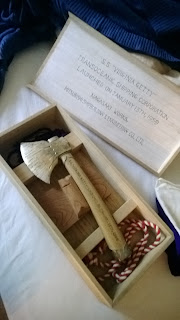
The silver hatchet that launched a ship


Monday, September 5, 2022

Money, love and freedom

The vast majority of genealogical research comprises seeking out documentation: certificates that give us birthdates, marriage (and divorce) dates, and death dates (and where the bodies are buried). We fill in with snapshots of the family unit with censuses (with notable lacunae in the 1890 US Census, and San Francisco and Irish records lost to fire). If we're really lucky, their names may pop up in the newspaper--something as mundane as a property transfer, or, maybe something substantive, like a golden anniversary celebration or obituary. All of these can be documented and have a place in the GEDCOM data structure.

To that framework, we can make a few assumptions: the span of time between a marriage and the birth of the first child is usually a bit more than nine months--though sometimes it is significantly less. Sometimes a family heirloom will mark a date and furnish additional clues: a diploma, a journal, letters to distant family members about how things are going, and memoirs (almost always unfinished). 

But the hardest question to answer is rarely "when?" or "where?" or even "with whom?"; it's "why?"

This is where we rely on history and family lore--oral hints passed down the generations, each with the projections and interpretations of the teller, combined with an understanding of what was happening in their world. Sometimes it's obvious: a holocaust survivor immigrating to Israel, an Irish family fleeing the potato famine, someone chasing gold in 1849. But most of the time, the motivation for these great leaps of courage--leaving the olde country, crossing seas and continents--remain conjecture, often colored by our own lives (what would I have done in that situation?).

In my case, my Irish relatives came to the US in the 1830s--long before the famine, and while there were some English and Scottish colonial period arrivals in the new world, some of my English relatives took a circuitous route to California, via Tasmania. (That they departed Tasmania for California in 1849 tells me that there was at least some economic motivation.). Some of hub's Prussian families were clearly fleeing the tough economics and threat of war in the run-up to 1848.

And so I go off with my own projections, and say I think it's usually a combination of seeking economic security, political or religious freedom, and love in a different place--moving to a place where we can be true to ourselves. In our own case, the decision to leave West Germany and come to the US was based on two things: there were no open positions for the career that my new husband had spent nine years preparing for, and being married to me meant that taking the risk of going to my home country was mitigated. For money and love.

1850 ship's manifest: can you find the Hellsterns?