Showing posts with label Jessie Dewey Cutting. Show all posts

Sunday, January 29, 2023

In the linen closet

When I was a young girl, I loved to sit next to my grandmother and listen to her stories. It was on her lap that I learned to read, and first heard of the Mormon Tabernacle Choir and Lawrence Welk. She was a thoroughly modern Millie, and had a remote control--with a mute button!--in the 1970s. She had a disability that made walking difficult, so spent much of her time in bed or in a custom-made chair that made it easier for her to be comfortable. 

One of those mornings, she told me the story of how she was invited to christen a ship in Japan. She recounted how the Japanese didn't just have a bottle of champagne broken across the bow; they had developed a mechanism that included a silk cord that had to be cut across a block with a silver hatchet in one stroke. They provided her with a hatchet to practice, since it was purportedly bad if she failed to cut it in a single blow--sort of like birthday candles. She told of the day of the christening dawning very cold, how she was very nervous, and how it rained when she cut the cord--successfully.

Then she called to my grandfather Russell, asking him to bring her the hatchet to show me. He stepped over to the linen closet, of all places, and reached in and pulled out a beautiful presentation box, painstakingly inscribed with the date by a hand not used to the roman alphabet. Inside were nestled the hatchet, along with a section of the red and white silk cord and a cedar chopping block that showed a clean cut. 

Years later, we would find a folder of the official photographs, along with a VHS tape my uncle had made of the 5mm film that had been gifted to Jessie and Russell. It was a remarkable experience to see the event she had described that day (and many times later on as she slipped into the fog of dementia), and especially moving to see her alive and hear her voice. 

My eldest cousin James also enjoyed listening to the grandparent's stories, except he followed my grandfather around. Russell was a wiry, vital man who always seemed to be in motion--except when he sat down to watch golf. James was a budding journalist at the time, and in 1977, he sat down with our 82 year old grandfather and interviewed him about his extraordinary life, using the latest technology--audio cassette tapes. 

Shortly after my mother's death, I asked him if knew what had become of the tapes. He was in the midst of moving and preparing a book for publication (The Abolitionist's Journal) and told me he would keep an eye out for them. After the California storms of last month dropped a rather large tree on his home, he made a concerted effort to find them. Of course, it was his wife who located them--in the linen closet, of all places.

They are currently in the hands of my favorite digitizer. I'm hoping the result will contribute to these family history musings. 

The fabled hatchet in its presentation box


Sunday, September 11, 2022

Footsteps

In January of 1959, my grandparents were in Japan, on a work trip for my grandfather’s work. It was not their first trip there, though it was their last. My grandfather, Russell Richardson, was there as a representative of Tidewater Oil, to help rebuild their interest in several refineries that had been firebombed during the last sorties before the end of the war.

From an early age, I loved to sit next to my grandmother and listen to her stories (she also taught me to read during one of those sessions). One of her favorite stories was about the time she went to Japan to christen a ship. She would tell the story of how she had to chop a silk cord with a silver axe, and how she was so nervous. And then she would call my grandfather to get the axe out of the closet (she had hip dysplasia and walked only with great effort), and she would show it to me in its presentation box.

In 2019, my husband and I had the opportunity to travel to Japan, and the itinerary, dictated by his boss, would take us on a nearly identical route to that of my grandparents. I am fortunate to have both my grandfather's journal (a rather dry listing of destinations, timing, and the weather. We also have my grandmother's chatty letters home to her daughter (my mother). For a contemporary view, we also have my daily posts on social media. 

Their first destination in Asia, like ours, was Tokyo. We took a direct flight to Narita Airport: my grandparents spent a week on a steamer, crossing the date line on New Year's eve. Ironically, they were flown from Tokyo to points west, while we took advantage of the high-speed rail that has since been built. The other big difference was the weather--they were there in the cold of winter (January), and we arrived at the end of July, just in time for oppressive heat and humidity. They stayed several weeks ensconced  in a suite in the newly expanded Imperial Hotel (built by Frank Lloyd Wright); we found a reasonably priced hotel with air conditioning and relative peace in Shinagawa and headed east as soon as our jet lag allowed. 

We both stopped in Kyoto, where Grandfather's photos of the temples are black and white and deserted, in contrast to the vivid colors and hordes of tourists in our phone's pictures. His pictures show the odd car, and loads of people pulling handcarts or on foot. Today those thoroughfares are jammed with small boxy cars and busses. 

Our paths overlapped in Kurashiki. Russell writes:

“Okayama, Ar 5:31 pm Brass band to greet us. 9:30 go with Gov Miki in his car (car equipped with phone and short wave radio. Motorcycle escort) to Mimushima refinery site – about 40 min. Cold but clear. Take motor boat ride around site. Two barges dredging. Left site @ 11:30 stopped to inspect 7 or 8 dormitories purchased from prefecture. At Kurashiki visited the Ohara Art Museum and had a bit of lunch – Japanese style nearby.”

We followed his footsteps through the old town of Kurashiki, one of the few spared by the bombers. We visited the Ohara Art Museum and gardens, and saw the same paintings he did—and many more, as the collection has grown considerably since 1959. An aerial view of the refinery today shows it is still active, but we demurred adding it to our itinerary. Our lunch was Japanese, a tasty vegan curry, served in a beautifully restored house. And we started our day not with a brass band, but by climbing the hill to a shrine that overlooks the whole.

Our paths also crossed in Fukuoka and Nagasaki, the first on the far west coast, with spectacular views, the latter all too well known. Grandmother writes to her daughter: 

“We stayed all night in Fukuoka (it’s the size of Oakland) and left by train for Nagasaki the next morning. We were met there by a delegation & photographers & a little Japanese girl presented me with a big bouquet of chrysanthemums & tulips – red & yellow“

Its state makes us think that the train station does not appear to have changed a great deal since 1959, and there is an "Octoberfest" celebration in the station in full swing when we arrive, complete with bratwurst and beer--in July. 

There is a reason for our trips to Nagasaki. During his 37-year career working for Tidewater Oil (later Associated Oil), Russell worked his way up from a lowly bookkeeper to Vice President of the company. Tidewater partnered with Mitsubishi (the Japanese government would not allow foreign companies to own business outright) in building refineries in Japan in the 1930s, and in rebuilding in the aftermath of World War II. 

In recognition of his role, my grandmother Jessie was given the honor of sponsoring the tanker SS Virginia Getty in a January 1959 christening at the Mitsubishi shipyards in Nagasaki. Jessie continues: 

“We left the hotel at 10 next a.m. & drove to the ship yard – Boy, was I nervous. It was icy cold, windy & it rained except during the actual ceremony. Then the heavens opened up & it poured. When I chopped the cord, the balloon on the bow of the ship was opened up & confetti & pigeons flew out, & the Virginia Getty slid into the water.”

When I first heard we would travel to Japan, I was eager to go to Nagasaki, to the place of her story. I was not disappointed. In spite of the language barrier, we managed to reserve a tour and visit to the old Mitsubishi pattern shop, which houses the shipyard's museum. Once there, we had a private guide, since we were the only visitors who didn’t speak Japanese.

When we told our story to our guide, she disappeared for a few minutes and emerged with her arms full of albums of the building and christening of the Virginia Getty from their archives. She was also able to show us where in the shipyard she was launched, and we could share grandmother’s words and a photo of the hatchet used to launch her. I am deeply appreciative of her efforts, and found myself quite moved by seeing images of my grandparents again. 
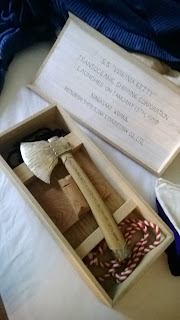
The silver hatchet that launched a ship


Saturday, December 5, 2020

Jessie Dewey Cutting (Richardson)

by Madge Richardson Walsh, 2001

Jessie Dewey Cutting was born in San Francisco on November 5, 1895, in the apartment building her grandfather Cutting built next door to his home (both were still standing in the 1980s). Jessie was the third of five children, with two older sisters and two younger brothers. Her parents were not particularly happy at having another girl; when her proud father had rhapsodized in the family Bible over the birth of the first two girls, endowing them with lovely names — Marjorie Adele, Ida Mary — number three was recorded simply as "another girl." No mellifluous name for her, either: she was named Jessie after her mother. 


The Cutting home was in Honolulu, where her father, Eugene Cutting, worked as a sugar broker. When Jessie was about 11, and after the 1906 San Francisco earthquake and fire, they moved permanently to the mainland. Her mother had made regular visits to San Francisco to have her children; all these trips except the last were made in sailing ships.

In the Bay Area, they had a house on Nace Avenue in Piedmont, and Jesse went to the Piedmont Avenue School. 

Another disappointment developed: Jessie was born with congenital bilateral hip dysplasia in which the hip fails to make a socket for the thigh bone, and could not walk until a specialist operated on her when she was three. For one hip, the operation was successful; the other was not so, and she always walked with a limp. In her later years, arthritis compounded the pain, and her movements were restricted and she tired easily.  

This was not a period where women were encouraged to go to college, but Jessie persuaded her parents to let her attend what was then the California School of Arts And Crafts. This was during the tenure of Frederick Meyer, of Perham Nahl, and Xavier Martinez. Despite little support for her work, she did finish school, and did her practice teaching in art at University High School in Oakland, and then went into commercial art. She illustrated such new clothing fashions for Capwell’s department store sale brochures. 

Capwell's Advertisement, Oakland Tribune, Oct. 13, 1922

We have two of her oil paintings, one a still life exercise, the other the tawny hills and oak trees in the Piedmont uplands. While her active art career was brief, she remained a wonderful teacher, as her patience was infinite.

+++

Jessie died in 1984; in a gesture of his deep love for her, Russell established a scholarship at her alma mater, which is now known as the California College of the Arts. The Jessie Cutting Richardson Memorial Scholarship is awarded annually to 1-3 full-time students who are either U.S. citizens or eligible noncitizens and who demonstrate financial need and academic merit at CCA. Her family continue to donate to the fund so that her memory may remain alive in the hearts and hands of its many recipients.

Saturday, January 21, 2017

Recipe: Crab stuffed sole

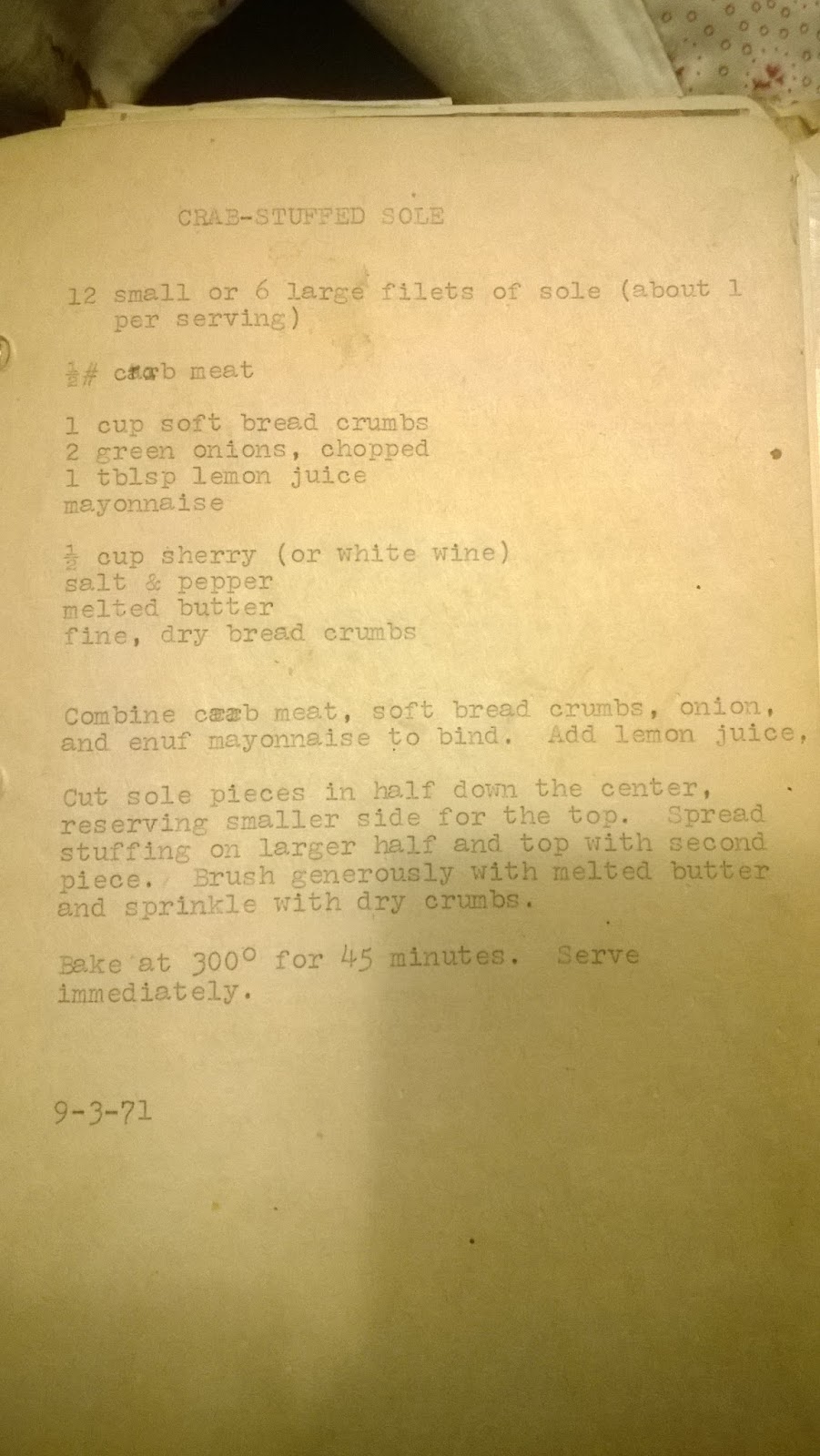
It was a staple on my grandmother Jessie Cutting Richardson's elegant table: crab stuffed sole, moist and delicious. Jessie was talented in the kitchen, preferring simple dishes with fresh ingredients. Her daughter Madge, however, was an intellectual, and like her father, needed a recipe to follow--slavishly.

In my childhood, I can remember the moist dish when eating at Grandmother's, but at home, it was dry and rubbery. I finally figured out why in 1986. My parents were moving from Portland, Oregon back down to Redding, California for their retirement, leaving us, their adult children, behind. Moving day was predictably hectic, and the plan was that after the van pulled away, they would come stay the night in my apartment. I would provide a well-earned shower, dinner and a bed. My mother handed me $20 and a copy of the recipe for crab-stuffed sole and said, "why don't you make this?"

The recipe in Madge's book

 A careful reader of the recipe will note that the method doesn't say what to do with the wine, so I added it before putting it in the oven so the fish would poach. At dinner, my mother was near tears as she noted that it was as delicious as when her recently-deceased mother had made it--and what did I do differently? We went through the steps, and when I said I added the wine, she exclaimed, "You added it? I always just drank it!"

While cleaning out her home last year, I found my grandmother's recipe box. Turns out those years of baked fish can be traced to a copying error. Use this version.

The recipe in Jessie's card file

Tuesday, July 12, 2016

Snapshots: Honolulu

by Jessie Emma Dewey (Cutting), ca. 1899 

Ida and Jessie on the porch - a picture from the same roll

 On the back it reads:

"Gene & I took these snaps - developed the plates & printed them - terrible
Ida -               
At corner of Beretania & Alexander St Honolulu. Cottage built by Chinese contractors - note Chinese architecture. Thot these snapshots might amuse you. I was going to destroy them but will let you do it."

The same intersection in 2016 (via Google Street View)

Saturday, June 11, 2016

Letter from Salina Cruz, 1919

A Letter from Russell Richardson to Jessie Cutting, Salina Cruz, Mexico

Salina Cruz, Mexico
3 p.m., Friday, March 28, 1919

Dearest,
            I had three letters ready to mail to you here, but the American consul says he wants to send some letters to the States by us – their mail service is so undependable, sometimes taking three weeks.
            There is quite a story to our arrival, so I shall go back and relate it in chronological order. At 7:30 this morning we anchored just outside the breakwaters to Salina Cruz Harbor.
            The motor dory was launched in the Captain sent Ted ashore in it to visit the consul and see if the dock was ready for us to oil. The sea was very rough and Ted got soaked from the spray before he had cut through the two breakers. They had just got off the bow of our ship when the engine died and they came drifting down on the ship. While the coxswain worked at the engine Ted fended her off. All of a sudden the engine started and with the wind and see in the same direction they were whisked from bow to stern in an instant. Then he circled about to get on his course and head for the gap between the two breakwaters. The little old dory rolled and pitched like an egg shell and when she climbed up a wave and suddenly reached the crest I swear she flew clear out of water. Not a few expected to see her capsize any instant. But once he got turned around it was all right, and he disappeared in ten minutes into the inner harbor.
            At ten he returned. We hoisted the boat and up anchor and headed in. The outer harbor is very small and the inner one smaller still. We aimed to pass through into the inner harbor and more alongside the dock – a sharp turn to our left.
            So far I have forgotten to mention that there is a terrific off shore wind blowing. I have never encountered anything like it. The mountains seem to form a funnel which collects the trade winds from a large area and concentrate them all to blow out of Salina Cruz Harbor. Many a hat was lost this morning – Lieut. Conover lost two (and they cost $12.50 each now.). When you went onto the forecastle you had to lean forward at a 45° angle and virtually claw your way into the wind. And on the bridge when we were underway heading into it, if you looked up with your eyes open the wind grabbed the lashes and pinned your lids down so that you couldn’t close them – making tears stream out. And if you put your head down and closed them, you could, only with great difficulty get them open in the face of the wind. ’S a fact.
            Well, in we went, slowing to 2/3 speed as we passed the breakwaters and to 1/3 halfway across the outer harbor. This entrance to the inner Harbor is 25 yards wide – the ship 31 feet. Allowing a little for the wind to carry us toward the left hand side, he headed straight for it. But the instant our nose entered the gap it was evident that she would not pass through without the ship hitting this concrete wall a glancing blow.

Russell's sketch superimposed over a satellite picture of the harbor today.

            Of course what I would have done under similar circumstances doesn’t make any difference – but I would have run up full speed and tried to skin through before we bumped at any rate: but he rang up 2/3 astern. Before the result of 2/3 astern was noticed we hit, just abaft of no. 4 smoke pipe. You could see the side bend in just like a football – but unlike a football it didn’t spring out again. The force of this impact through the stern out a bit and he grabbed this opportunity to try to forge ahead – going 2/3 ahead. To protect the propeller he stopped before she banged again and this time she bumped the propeller guard – bending this a little – though from the bridge, the skipper and all thought it had been carried away.
            As soon as she was clear he rang up two thirds again and cleared the entrance though it was perfectly evident that the beach was only a stones throw away – (I have drawn the chart true to scale). The instant the stern was clear he rang up two thirds astern but it was too late – we were going aground on the beach. So he let go an anchor to help stop his motion. We stopped all right when our nose ran into the sandy beach.
            Then we ran two lines ashore to the oil dock – from bow and stern. To do this we had to launch a boat – a dozen times this little dory nearly capsized but finally the lines were made fast. Then we heaved in on the lines and gave full speed astern on the engines and she came off slick as an ax. By noon we were tied up and oil coming aboard. It didn’t seem to worry Capt. Fletcher any. He was very cool all the time and never swore or showed any signs of weakening.
            After lunch he ordered me to go to the American consul – report our arrival and tell him that so far as he, Capt. Fletcher, was concerned, the official call of courtesy by the consul might be omitted, for he himself would call on the consul at 2:30. The consul was agreeable and so the Capt. is making his call.
            Dressed in my spiffy whites, down the main streets of Salina Cruz to call on the consul I felt like quite a personage.
            The place boasts 5000 inhabitants and four white people. It is typically Mexican – the numerous hounds – scantily clad, barefoot natives. Fruit vendors mostly women, met us on the dock. In town the narrow sandy streets are deserted except for a wild pig here and there and prehistoric wooden carts with cumbersome wooden wheels drawn by runty, bony, oxen. Nothing seems to thrive, the children are skinny, all are small of stature and the men can’t even grow a healthy appearing mustache. A flock of goats and kids obstructed the crossing at one street and even they were stunted, scrawny animals.
            We passed the city garrison. An ordinary Mexican structure was a long veranda along its front. The wall was completely covered with cartridge belts, hung there and numerous rifles leaned against it. A sentinel stood by the door in a strictly military posture, absolutely rigid, the gun by his side almost as long as he was tall. He looks neither to the right or left – yet I believe he saw everything. Next to the irregular mass of flat rocks bordering the street which I took to be a sidewalk was built a barricade of brick four feet high and two feet thick with rifle slits in it every few feet.
            Love in a hurry - Russell